During my 1L year, I feel like I lost a part of myself in the sense that I didn’t partake in the things that normally gave me joy/pleasure, because I was so overwhelmed by all the noise and pressure around me. I could only engage in completely passive, mindless activities that allowed me to stay in a numbed state of escape (e.g. binging on fluffy, lighthearted sitcoms). But now that I’ve survived that dark period of my life, I’m starting to fall back into the forgotten joy of leisure reading.
I’ve picked up the Neapolitan Novels series after a recommendation from a friend, a fellow reader. I have neglected fiction in so long, especially working up to law school, because I felt I had to be a more “serious” reader and stick to non-fiction.
Despite the rather cheesy covers and titles, the series has really resonated with me in a way that I didn’t imagine. The author really strikes the intricacies of female friendships, which is honestly illustrated in the extreme competitiveness yet deep love that best friends, Lenu and Lila, have for each other. And though they spend years apart, envious and somewhat embittered by each others’ lives, they always have a way of springing back to each other in their darkest moments and finding the other in their own actions and thoughts. Though I find myself relating to the level-headed and academically-oriented Lenu, I can’t help but feel empathy for the maddeningly brilliant, yet tragic Lila – especially by then end of Book 2. And though the violence and misogyny in the novels can be rather disturbing, the class and gender dynamics make the novels more contextually enriching. Also, they’re turning it into a show on HBO, which I’m extremely excited about.
I loved this passage below about Michele (the biggest douche that ever graced the stradone) and his unbreakable and unrequited love for Lila:
“At a certain point Michele himself must have realized it, and he became gripped by a kind of melancholy. He had murmured that women for him were all games with a few holes for playing in. All. All except one. Lila was the only woman in the world he loved—love, yes, as in the films—and respected… He had told her that he thought about Lila night and day, but not with normal desire, his desire for her didn’t resemble what he knew. In reality he didn’t want her. That is, he didn’t want her the way he generally wanted women, to feel them under him, to turn them over, turn them again, open them up, break them, step on them, and crush them. He didn’t want her in order to have sex and then forget her. He wanted the subtlety of her mind with all its ideas. He wanted her imagination. And he wanted her without ruining her, to make her last. He wanted her not to screw her—that word applied to Lila disturbed him. He wanted to kiss her and caress her. He wanted to be caressed, helped, guided, commanded. He wanted to see how she changed with the passage of time, how she aged. He wanted to talk with her and be helped to talk. You understand? He spoke of her in way that to me, to me—when we are about to get married—he has never spoken. I swear it’s true. he whispered: my brother, Marcello, and that dickhead Stefano, and Enzo with his cheeky face, what have they understood of Lila? Do they don’t know what they’ve lost, what they might lose? No, they don’t have the intelligence. I alone know what she is, who she is. I recognised her. And I suffer thinking of how she’s wasted. He was raving, just like that, unburdening himself. And I listened to him without saying a word, until he fell asleep”
Elena Ferrante | Those Who Leave and Those Who Stay



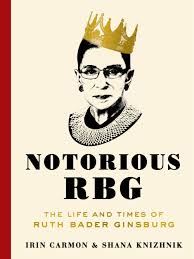 I’ve recently purchased Notorious RBG as I was casually perusing through the Rizzoli bookstore when I had to kill time. I figured I needed some new law school inspo, and I’ve known about Ruth Bader Ginsburg and that she was somewhat of a badass (an 80+ year old woman serving on the Supreme Court is pretty badass in and of itself). It was amazing to read the breakthroughs she made as a woman in the legal field (top of her class at both Harvard & Columbia Law, one of the first women to teach law, the second woman to be on the Supreme Court) as well as what did for women through law (rights for pregnant women, rights for women in the military, etc.). And it was interesting to see how she wasn’t this highly aggressive, in-your-face type of lawyer either; she was someone who was strong but reserved, and she preferred working slowly but effectively rather than quickly trying to turn things upside down.
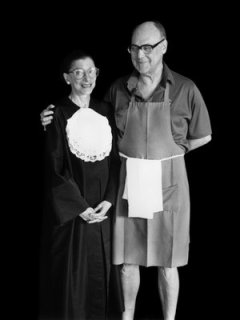 they connected instantly. When thinking about their future together, Marty suggested that they work in the same profession so they could speak the same language and have more to bond over; they both decided on law. As they both studied at Harvard Law, Marty was diagnosed with cancer during his second year. RBG didn’t want him to fall behind so she helped him with his work on top of her heavy courseload. That’s when she realized she could survive off of one hour of sleep. She made more sacrifices for him & her family throughout her life: she gave up her Harvard Law degree to move to NY with Marty when he got a job at a top-notch NY firm and she put her career on hold to raise their children. However, what’s beautiful about their marriage is that he did the same for her when it became her time to shine; Marty’s the one who encouraged and recommended her for the position on the Supreme Court and he became a house-husband (& an amazing chef) later in their lives so that she could excel in her career.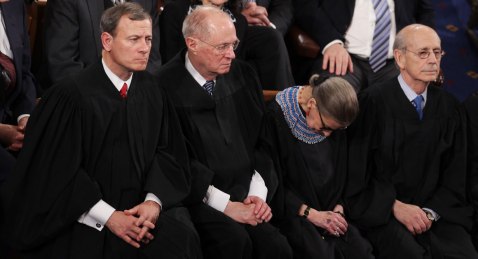
 small soggy fry